
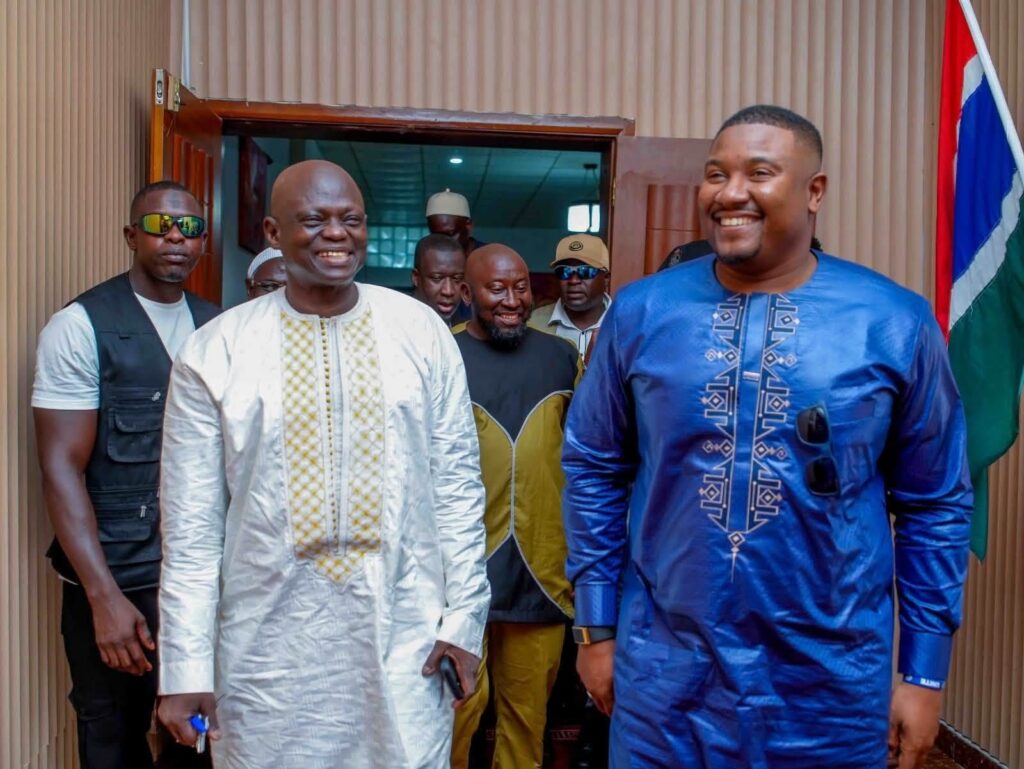
Fatoumatta: Some political commentary does not seek to illuminate but to agitate; it does not interrogate facts but arranges them like stage props; it does not aspire to intellectual honesty but to theatrical suspicion. Musa Bassadi Jawara has, once again, chosen that path. His latest missive, a melodramatic prophecy of “political divorce” between Mayor Talib Ahmed Bensouda and Dr. Lamin J. Darbo, is not analysis. It is performance. And like all performances, it relies on exaggeration, selective memory, and a conspicuous absence of context.
The tragedy is not that Jawara writes. The tragedy is that he writes as though Gambians have no political memory, no capacity for discernment, no understanding of how coalitions function in real time. His argument rests on a single, brittle assumption: that silence is betrayal, that absence is abandonment, and that political chemistry must be performed on podiums rather than negotiated in private rooms where real strategy is forged.
Let us begin with his first pillar, the so‑called “Brikama Podium Test.” Jawara insists that Dr. Darbo’s speech did not praise Talib Bensouda enough. This is a curious standard, one borrowed from American presidential running‑mate theatrics, not from Gambian coalition culture. Coalitions are not beauty pageants. They are not designed for sycophantic recitations of loyalty. They are built on complementary strengths: administrative competence, legal rigor, ideological clarity, and strategic depth. Dr. Darbo’s presence on that podium was itself a signal, a public affirmation of partnership. To demand that he perform cheerleading is to misunderstand both his temperament and his political value. Serious men do not shout slogans; they build structures.
Jawara’s second claim—that two weeks of public silence amounts to political abandonment — is equally flimsy. Coalitions are not maintained through daily press releases. They are maintained through coordination, negotiation, and strategic alignment. Dr. Darbo’s silence does not mean he was absent from coalition deliberations. Gambian politics has suffered enough from loud men who mistake noise for leadership. Silence, in moments of legal uncertainty, is often prudence, not disloyalty.
His third argument, the “Salikenni Snub”, is perhaps the most revealing. Jawara interprets physical absence as political rupture. But coalition partners do not need to shadow each other’s every movement across the country. Campaigns are divided by regions, constituencies, and strategic priorities. The absence of Dr. Darbo or NUP representatives at a single rally is not evidence of divorce; it is evidence of logistical reality. Gambian politics is not a theatre troupe where every actor must appear in every scene.
Then comes the most audacious claim — that Dr. Darbo’s stature, cultural grounding, and professional pedigree make it impossible for him to support a younger leader. This is not analysis; it is projection. It is the kind of argument that reveals more about the writer’s own insecurities than about the subject. Dr. Darbo left the UDP on principle, not on ego. He has repeatedly demonstrated that leadership is measured not by age but by integrity, competence, and vision. To suggest that he cannot work with Talib Bensouda is to misunderstand the very nature of principled politics.
Jawara’s final flourish — the warning that Dr. Darbo’s participation in signing an agreement with Team Gambia signals imminent divorce — is a masterclass in speculative fiction. Coalitions evolve. Agreements are signed. Partners negotiate. None of this proves rupture. It is evidence of political maturity. The only person who sees divorce is the one who desperately wants to predict it.
Fatoumatta: What is most striking in Jawara’s piece is the contradiction at its heart. He ends by praising Dr. Darbo as a noble, selfless, pro bono defender of the marginalized, a man of unassailable moral record. Yet he simultaneously portrays him as fickle, disinterested, incompatible, and on the verge of abandoning his coalition partner. You cannot canonize a man and caricature him in the same breath. That is not analysis; it is intellectual acrobatics.
The truth is simpler, quieter, and less theatrical than Jawara’s narrative. Coalitions are complex organisms. They breathe, adjust, recalibrate, and evolve. They are not judged by two weeks of public appearances but by long‑term strategic coherence. Talib Bensouda and Dr. Lamin J. Darbo represent two distinct but complementary traditions in Gambian public life: administrative reformism and legal constitutionalism. Their partnership is not a marriage of convenience; it is a convergence of necessity. The country’s political future demands competence, integrity, and institutional seriousness. Both men embody those qualities.
Jawara’s commentary is not dangerous because it is critical. Criticism is healthy. It is dangerous. It is fallacious because it seeks to manufacture suspicion where none exists, weaponizes absence, interprets silence as treachery, and confuses performance with reality.
Fatoumatta: Gambia deserves better political analysis than this. It deserves commentary rooted in fact, not theatrics; in context, not conjecture; in intellectual honesty, not showmanship. And it deserves observers who understand that coalitions are not broken by two weeks of silence; they are broken by the kind of reckless speculation that Jawara has chosen to indulge.