
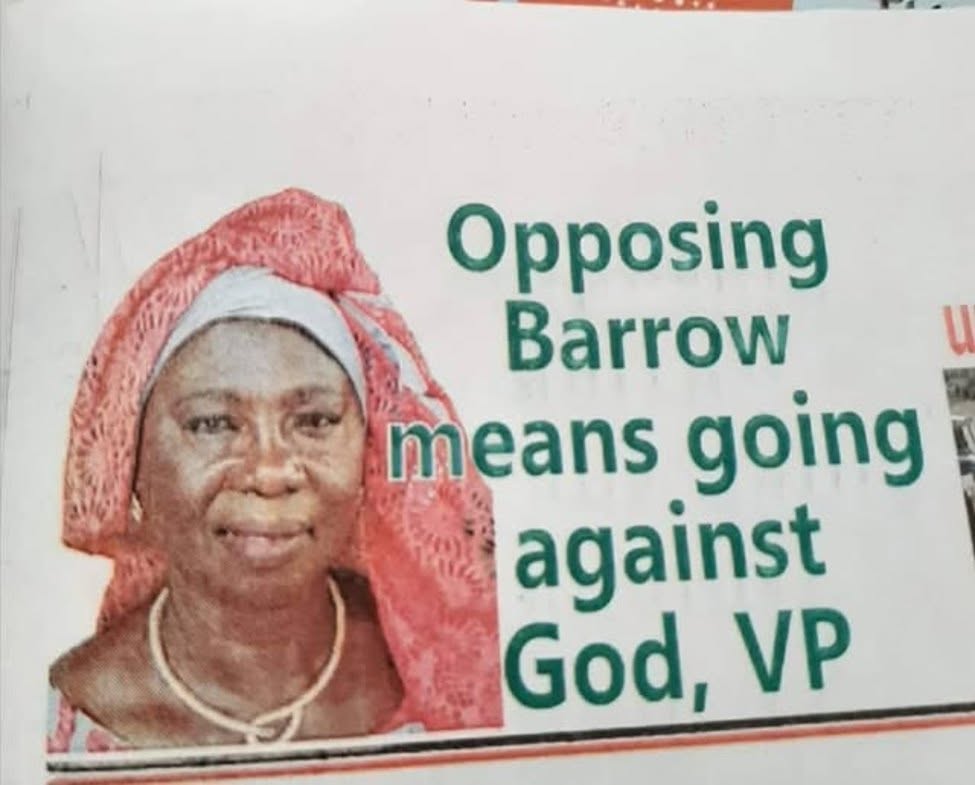
Fatoumatta: In Gambian politics, principle is scarce, and flattery is common. Leaders often praise like loyal followers yet contradict themselves without hesitation, creating a crisis of conviction.
In a political climate where loyalty shifts with the seasons and morality is up for negotiation, Gambians face a tough question: What does leadership mean when words lose their truth? From Dr. Isatou Touray’s claim “Opposing Barrow is opposing God” to Ousainou Darboe’s declaration that “Barrow is our Moses,” the nation wrestles with a crisis of conviction that puts its democracy at risk. Words aren’t just political props; they carry moral weight. Fattery has become the drug of the political elite, addictive, destructive, and ultimately self-defeating.
At the core of Gambian politics lies a moral wound, one caused not by poverty or underdevelopment, but by a loss of principle. In a country still recovering from dictatorship and trying to shape its democratic identity, the greatest danger isn’t a lack of leaders—it’s the lack of conviction in those who claim to lead.
Fatoumatta: There comes a moment in every nation’s political evolution when the question is no longer who is running for office, but what moral compass guides those who seek to govern. The Gambia, in this fragile democratic interlude, stands precisely at that crossroads. Our politics is no longer merely a contest of ideas; it has become a theatre where conviction is negotiable, morality is seasonal, and principle is a costume worn only when convenient.
Right now, Dr. Isatou Touray’s return to frontline politics after her departure as Vice President calls for a clear, honest look. It’s not about questioning her right to pursue political goals, but about recognizing that leadership carries moral weight, and the public doesn’t simply forget the past.
For leadership is not merely the pursuit of power; it is the stewardship of truth. And truth, once spoken, binds the speaker. When Words Become Shackles In 2019, as Vice President, Dr. Touray declared that “Opposing President Barrow is like opposing God.” A statement of such theological absolutism is not a slip of the tongue. It is a deliberate elevation of political loyalty to the realm of divine obedience. It is the kind of rhetoric that corrodes democratic culture, delegitimizes dissent, and sanctifies power.
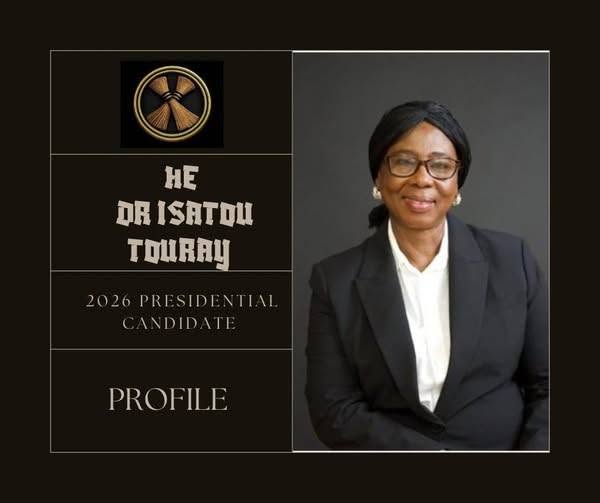
Now, in 2026, Dr. Touray has launched her own presidential campaign, directly opposing the very man she once compared to divine authority. The contradiction is hard to ignore. This isn’t about political maneuvering; it’s about moral consistency. If opposing Barrow was once like opposing God, then by her own logic, she now opposes the divine. If that statement was an exaggeration, it was reckless. If it was flattery, it was risky. If it were sincere, her current run would be a betrayal of her own beliefs. So the question remains: Where’s the principle? The conviction? The morality?
Dr. Touray is a brilliant orator, a respected activist, and a woman of undeniable courage. But even the most educated can succumb to the seduction of power. Her 2019 statement was not merely unfortunate; it was a textbook example of how sycophancy can deform the judgment of even the most accomplished minds. History teaches us that truth can be delayed, but never defeated. The record remains. Words matter. And public trust is built not on eloquence, but on consistency.
Political sycophancy is not a Gambian invention, but it has become a Gambian epidemic. It is the art of praising leaders beyond reason, beyond truth, and beyond dignity, not out of belief, but out of calculation. It is the currency of those who seek proximity to power rather than service to the people. Sycophancy is dangerous because it distorts governance. It blinds leaders to their failures. It rewards loyalty over competence. It elevates flattery over truth. And it turns intellectuals into court poets.
Fatoumatta: The return of Dr. Isatou Touray to frontline politics and the theological fervor with which Ousainou Darboe once praised President Barrow are not isolated episodes. They are symptoms of a deeper crisis: the normalization of political sycophancy. In 2019, Dr. Touray declared that “Opposing Barrow is like opposing God.” In 2018, Ousainou Darboe proclaimed that “Barrow is our Moses.”
These are not metaphors. They are theological endorsements of political authority — the kind of rhetoric that blurs the line between governance and divinity. Such statements are not merely inappropriate; they are dangerous. They elevate leaders beyond accountability and reduce citizens to worshippers. When political actors invoke God to sanctify power, they commit a double violation: They insult theology, and they undermine democracy.
Today, Dr. Touray has launched her own presidential bid. She is now opposing the very man she once equated with divine authority. The contradiction is glaring. It is not a matter of political evolution; it is a matter of moral coherence. If opposing Barrow was once opposing God, then what does her candidacy represent? If the statement was sycophancy, then it was reckless. If it were sincere, then her ambition is an act of self‑contradiction. Leadership demands consistency. Public trust demands integrity. Words matter.
But Dr. Touray is not alone. Darboe’s “Moses” declaration was equally sycophantic, a moment when political loyalty eclipsed theological restraint and intellectual sobriety. These statements reveal a political culture where leaders praise excessively when in power and contradict themselves when out of power. This is not leadership. It is opportunism dressed in the robes of public service.
Sycophancy has become the lingua franca of Gambian politics. It is the currency of those who seek favor rather than truth. It is the habit of professionals who sing hosanna in the morning and crucify him in the evening, not because truth has changed, but because power has shifted.
Fatoumatta: Dr. Touray’s legacy is significant. She fought FGM. She survived Mile 2. She helped build the 2016 Coalition. She served in multiple ministries and rose to the rank of Vice President. These achievements deserve respect. But leadership is not only about what one has done; it is also about what one says — and whether one stands by it when the winds change. The same applies to Darboe, a man whose decades‑long struggle for democracy is undeniable, but whose words in moments of political intimacy have sometimes betrayed the very principles he fought for.
It would be unfair to overlook Dr. Touray’s impact on national progress. She’s been a trailblazer in the fight against Female Genital Mutilation (FGM), co‑founding GAMCOTRAP in 1984. In 2010, she was arrested, held at Mile 2, and later cleared of charges widely seen as politically driven. She opposed Jammeh’s dictatorship, played a key role in building the 2016 Coalition, served as Minister of Trade and Health, and eventually as Vice President. These are no small feats. But leadership isn’t just about past actions—it’s also about words and whether one stands by them when circumstances change. The broader problem in Gambian politics is the lack of principled consistency.
The Gambia is suffering from a crisis of conviction. Our leaders speak in absolutes when it suits them and retreat into ambiguity when circumstances shift. They invoke God when in power and invoke democracy when out of it. This is not the politics of principle. It is the politics of convenience. A nation cannot be built on such foundations. Democracy requires leaders who understand that words are not disposable. They are covenants with the public. They are markers of character. They are the architecture of trust.
Fatoumatta: The Gambian crisis of conviction is clear. Our political groups, institutions, and even civic spaces have grown more sycophantic. People say one thing today and the opposite tomorrow, depending on where power shifts. Activists turn into ministers and forget the language of accountability, while ministers become critics and forget the language of loyalty. The cycle repeats, and the nation pays the price. We’ve built a political class that shouts praise in the morning and calls for crucifixion in the evening — not because the truth has changed, but because opportunity has. This isn’t leadership; it’s opportunism dressed up as public service.
True leadership isn’t about talking; it’s about having the courage to back up your words. A real leader is driven by principles, grounded in conviction, and guided by a strong moral compass. They know their words matter—they’re promises, commitments, and reflections of character. When leaders treat their own words carelessly, they send the message that truth can be bent or bargained.
Leadership is not the pursuit of office; it is the pursuit of purpose. Leadership is not the accumulation of titles; it is the accumulation of trust. Leadership is not the ability to speak; it is the courage to stand by one’s words. A leader must be guided by principle, anchored by conviction, and restrained by morality. A leader must understand that truth is not seasonal. It is not negotiable. It is not a tool for political convenience.
With Dr. Touray stepping back into politics and Darboe continuing to influence the national conversation, Gambians have to reflect: What do we really want from our leaders? Is it eloquence or integrity? Ambition or principle? The future of our democracy hinges on our answers. In the end, leadership isn’t about who shouts the loudest; it’s about who speaks the truth and stands by it.
Fatoumatta: Leadership is a moral vocation. It demands coherence between word and deed. When leaders invoke God to sanctify political authority, they cross a line that no democracy can afford to ignore. Dr. Isatou Touray’s declaration that “Opposing Barrow is opposing God” and Ousainou Darboe’s proclamation that “Barrow is our Moses” are not mere rhetorical flourishes. They are theological distortions and political betrayals.
Such statements reveal a deeper crisis: the collapse of principle in Gambian politics. Sycophancy has become the national dialect — a language spoken fluently by those who praise excessively when in power and contradict themselves when out of it. The tragedy is not that leaders change their minds. The tragedy is that they change their moral compass.
Dr. Isatou Touray has every right to run for president, with her experience, intellect, and national profile. But she faces a question of her own making: if opposing Barrow once meant opposing God, what does it mean now that she stands against him? The country deserves an answer — not for political theatrics, but for moral clarity. Leadership without principle is just performance, and after enduring decades of authoritarianism and years of democratic stagnation, The Gambia needs leaders to speak the truth fearlessly and uphold it without compromise.
Fatoumatta: A nation can’t thrive on shaky foundations. Good leadership means being steady, having the humility to admit mistakes, and the courage to stand by what’s right. It’s about knowing that words aren’t just political decorations—they’re promises with moral weight. The Gambia needs leaders who speak honestly, not for convenience. Leaders who see power as fleeting but truth as lasting. Leaders who understand that democracy grows stronger through honesty, not empty praise. In the end, it comes down to this: Do we want leaders who chase power, or those who live by principle? The choice will shape the future of our republic.