
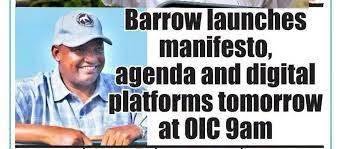
Fatoumatta: There’s something both telling and ironic about the National People’s Party gearing up to unveil a sleek, digitally polished 2026 manifesto at the Sir Dawda Kairaba Jawara International Conference Center. It’s more than just another political gathering—it’s a reflection of the entire Gambian political scene. It lays bare a truth we’ve long avoided: The Gambia is overflowing with political parties but starved of real political ideas.
As President Adama Barrow prepares to unveil the NPP’s 2026 manifesto, complete with digital platforms, AI tools, and a Nine‑Point Development Agenda, a deeper question emerges: why do so many Gambian political parties exist without manifestos at all? In a democracy where ideas should matter, the absence of governing visions reveals a troubling crisis at the heart of our political culture.
The Gambia is entering a decisive political moment not because of a scandal, a coalition drama, or a sudden shift in alliances, but because of something far more fundamental: the launch of a manifesto. The National People’s Party, under President Adama Barrow, is preparing to unveil its 2026 manifesto in a grand ceremony at the Sir Dawda Kairaba Jawara International Conference Center. In a mature democracy, this would be routine. In The Gambia, it feels exceptional. And that is precisely the problem.
A manifesto is the most basic instrument of democratic accountability. It is the written contract between a political party and the people it seeks to govern. It is where ideas are tested, priorities declared, and visions articulated. Yet in our political culture, manifestos have become rare artifacts produced by a few, ignored by many, and misunderstood by most.
PDOIS has always treated manifestos as sacred texts of political responsibility. From its inception, the party has published, updated, archived, and circulated its governing blueprints with academic discipline. Whether one agrees with PDOIS or not, the party has always taken ideas seriously. The UDP, too, has articulated a recognizable Five‑Point Economic Agenda, a framework that signals priorities and invites scrutiny. These are the marks of political seriousness.
But beyond these three PDOIS, UDP, and now NPP, the political terrain becomes barren. The Gambia is littered with registered political parties that have never produced a manifesto, articulated a governing vision, or presented a coherent plan for national development. Many exist only on paper, in press conferences, or on social media. Some were formed out of personal ambition, others out of frustration, and others simply because the IEC registration process is cheap enough to allow anyone with a loan, a sponsor, or a wealthy friend to register a party.

Fatoumatta: If a party can’t clearly express its vision, it has no real claim to power. Without a manifesto, it stands on shaky ground. Without a plan, its criticism holds no weight. Democracy isn’t a talent show or a popularity contest—it’s meant to be a battle of ideas.
Some say Barrow lacks standout credentials, yet he’s rolled out a well-organized democratic and economic policy. Meanwhile, his opponents haven’t offered a single alternative plan. It’s not really praise—more of a paradox, showing that competence can appear in unexpected places, while incompetence can hide where you think it won’t. Launching a digital manifesto is shaping up to be one of The Gambia’s major tests of democratic maturity.
A political party without a manifesto isn’t really a political party; it’s just a logo, a color, a slogan, a Facebook page, a microphone. Yet these same parties run for the presidency, ask for votes, and insist they offer “alternatives.” Alternatives to what? Based on what? With what plan? And with what kind of serious thinking?
President Barrow — often dismissed by critics as lacking a technocratic pedigree — is launching a manifesto, unveiling digital platforms, and presenting a structured Nine‑Point Development Agenda. Meanwhile, some of the loudest voices challenging him have not produced a single document outlining what they would do differently. This is not praise. It is a paradox. It reveals a deeper crisis in Gambian political culture: competence is not always where we expect it to be, and incompetence is not always where we assume it is.
The NPP’s digital innovations an interactive website, a mobile app, AskBarrowAI, Barrow Radio & TV, multilingual translations, and sign‑language versions — represent something new in Gambian politics. Whether these tools deliver substance or spectacle remains to be seen. But they signal a shift: political communication is entering the digital age, and parties that cannot adapt will be left behind. The Gambia is a young country. A digital country. A country where political engagement increasingly happens on smartphones, not at bantabas. A party that cannot speak the language of the future cannot claim to lead it.
But the deeper crisis is not technological. It is intellectual. It is the poverty of political imagination. It is the refusal of many parties to articulate a governing vision. It is the comfort with noise over ideas, outrage over policy, personality over principle. The Gambia has become a country where political ambition outpaces political thought, where the desire for power is not matched by the responsibility of planning.
The 2026 election will not be decided by manifestos alone. But manifestos matter. They force parties to think. They force citizens to question. They force the media to analyze. They force the political class to move beyond insults, tribal rhetoric, and personality cults. A democracy without manifestos is a democracy without memory. A democracy without ideas is a democracy without direction. A democracy without plans is a democracy waiting to fail.
The launch of the NPP manifesto is not simply a political event. It is a national audit. It exposes the intellectual poverty of many Gambian political parties. It challenges the culture of empty rhetoric. It forces a reckoning with the meaning of leadership.
Fatoumatta: The Gambia needs parties with real ideas, not just microphones. Parties with concrete plans, not flashy posters. Parties with manifestos, not empty noise. If 2026 is to mark real change, it has to start with one simple fact: a nation can’t be built on slogans — it’s built on ideas. So why do so many Gambian parties lack vision? What does it say about our politics when so few publish manifestos? And how long can democracy survive if ambition keeps outpacing ideas?