
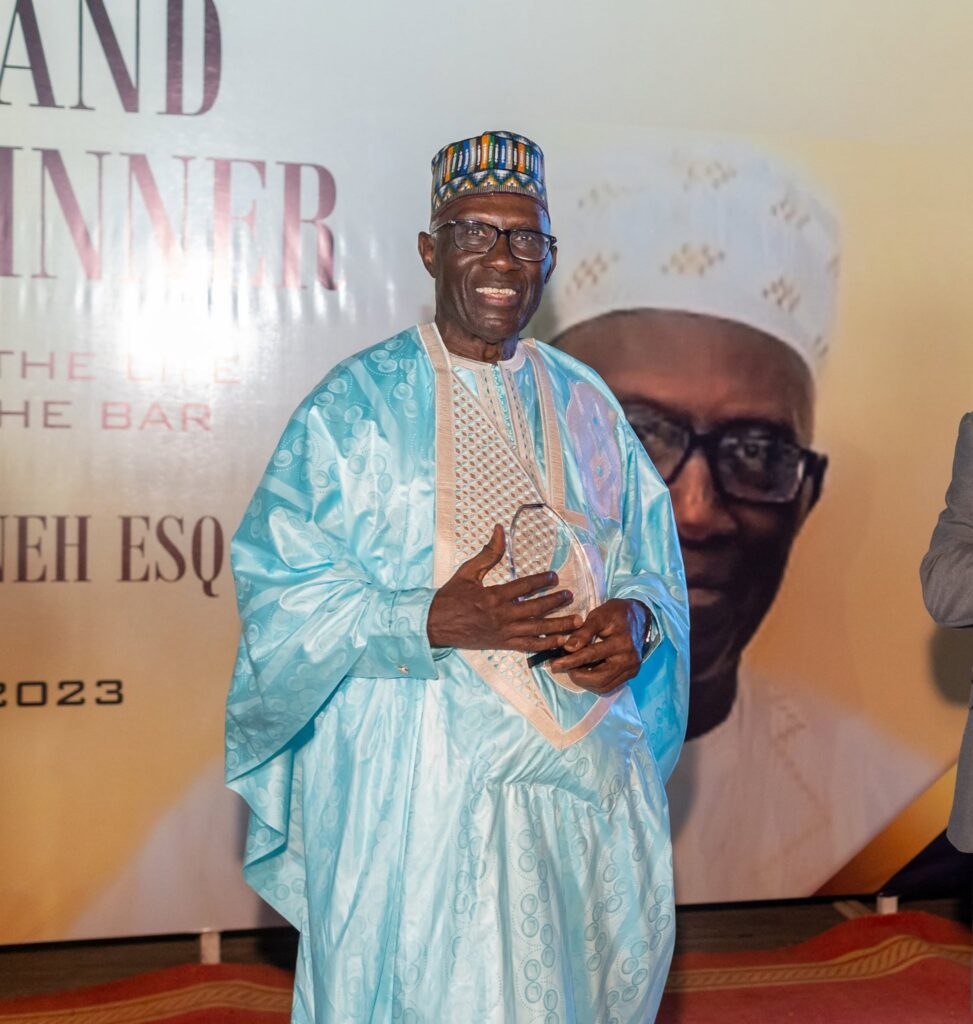
Author’s Note.
Fatoumatta: In a week dedicated to honoring the custodians of our Republic’s conscience, today’s Thursday Tribute turns its gaze toward one of the most consequential legal minds in Gambian history. Barrister Sourahata Baboucarr Semega‑Janneh stands among that rare generation of jurists whose courage fortified the nation when its institutions trembled. His intervention on August 23, 1999, when he confronted the dictatorship’s attempt to shutter The Independent through bureaucratic sabotage, remains one of the most principled acts of legal defiance in our modern history. At a time when fear governed the civic atmosphere, and silence was the safer currency, Janneh chose the harder path: he wrote, he challenged, he stood ready to go to court, and in doing so, he helped keep the Republic upright.
This tribute celebrates not only the man but the moral architecture he helped build—an architecture that continues to shape Gambian jurisprudence long after his generation has left the courtroom stage. As the nation reflects on its democratic journey, we honor a legal luminary whose integrity, restraint, and courage remain a benchmark for all who carry the law as a covenant rather than a profession. Today, we remember Sourahata Janneh not merely as a lawyer, but as a guardian of the Republic.
Fatoumatta: On August 23, 1999, at the height of Yahya Jammeh’s authoritarian grip, one quiet, unbending jurist stepped forward when the nation trembled. Barrister Sourahata Baboucarr Semega‑Janneh confronted the regime’s attempt to shut down The Independent through bureaucratic sabotage, writing a blistering constitutional rebuke and preparing to face the dictatorship in court. Today, we honor the legal luminary whose courage fortified the Republic when law was all we had.
There are moments in a nation’s history when courage is not declared in speeches but enacted in silence—when a single act of principled defiance steadies the Republic more than any proclamation. On August 23, 1999, at the height of Yahya Jammeh’s dictatorship, when fear governed the civic atmosphere and the state perfected the art of suffocating dissent through administrative traps, one jurist refused to bow. Barrister Sourahata Baboucarr Semega‑Janneh, gentleman advocate and constitutional sentinel, stepped forward when others stepped aside. The Independent newspaper—newly born, defiantly critical, and already marked for destruction—was ordered closed under the pretext of tax irregularities. The Commissioner of Income Tax, Samba Saye, acting under political instruction, refused to accept the paper’s lawful payment so that the regime could shutter it without ever entering a courtroom.
Many lawyers whispered their outrage privately. Many weighed the risks and retreated. The dictatorship was unpredictable, vindictive, and merciless. But Janneh, with the calm courage of a seasoned jurist, did what few dared: he confronted the state openly. He wrote a blistering letter to Commissioner Saye—copied to the Attorney General—declaring the refusal unconstitutional, dangerous, and an affront to the Republic. He warned that the state could not weaponize tax law to silence a newspaper. And he did not stop at warning. He prepared to go to court. He was ready to stand before a judge and challenge the regime at a moment when such defiance carried real personal peril. It was an act of jurisprudential patriotism in a season of national fear, a reminder that even under tyranny, the law still had guardians.
Fatoumatta: That singular intervention—simple in form, monumental in consequence—revealed the essence of Sourahata Janneh: a jurist whose fidelity to principle outweighed the intimidation of power; a man who held the Republic together when all we had was the fragile shield of legality; a legal architect whose courage fortified the nation’s spine when fear was the national currency.
In the long arc of Gambian jurisprudence, few figures have shaped the nation’s conscience as profoundly as Barrister Sourahata Baboucarr Semega‑Janneh. A gentleman advocate of rare courage, he confronted dictatorship when silence was safer, defended press freedom when truth was under siege, and later led the Janneh Commission with the moral clarity of a jurist who understood that accountability is the Republic’s last line of defense. In a generation of legal titans, Janneh stood apart—quiet, principled, unbending—a Commonwealth‑caliber oracle whose legacy endures in every institution he fortified and every freedom he helped preserve.
Every nation has lawyers, but only a few ascend into that rare realm where jurisprudence becomes moral architecture and legal practice becomes a form of national stewardship. In The Gambia, one such figure stands in the pantheon of our most consequential public servants: Barrister Sourahata Baboucarr Semega‑Janneh, doyen of the Bar, constitutional oracle, and gentleman advocate whose courage fortified the Republic when fear was the national currency. To call him a lawyer is true, but it is not enough. Janneh is a legal architect, a moral compass, a defender of democracy, a man whose intellect, restraint, and courage shaped the nation’s jurisprudence across five decades.
He belongs to that generation of Gambian legal titans—Justice Hassan Bubacar Jallow, Ousainou Darboe, Fafa Edrissa Mbai, Antouman A.B. Gaye, Ousman Sillah—men who carried the law not as a profession but as a covenant. They were the Gambian equivalents of Achebe’s “men of the people,” Soyinka’s “tigers of principle,” Ngũgĩ wa Thiong’o’s “writers in the house of truth,” and Camus’ “just men” who refuse to surrender to absurdity. In their company, Sourahata Janneh stands not as a footnote, but as a pillar. He is the quiet force in a generation of thunder.
His courage was tested early, and history remembers the moment. In 1999, Yahya Jammeh’s regime perfected the art of bureaucratic strangulation—closing newspapers not with court orders, but with administrative traps. The Independent, newly launched and defiantly critical, published a statement from the UDP calling Jammeh “the richest person in the region” and “the most corrupt head of state in Africa.” Days later, the Ministry of Justice ordered the paper to cease publication. The pretext was tax registration; the motive was political suffocation. Though The Independent had already registered with the Registrar General, the government weaponized a secondary income‑tax requirement to shut it down. When the paper attempted to pay its dues, Commissioner Samba Saye, acting under instructions, refused to accept payment. The Ministry of Justice issued an order: do not accept tax from The Independent. The goal was simple: close the paper outside the courts.
Fatoumatta: It was a moment of national fear. Lawyers whispered. Many declined to intervene. The dictatorship was unpredictable, vindictive, and merciless. But one man stepped forward. Sourahata Janneh, with the calm courage of a seasoned jurist, agreed to represent The Independent. He wrote a blistering letter to Commissioner Samba Saye, copied to the Attorney General, declaring the refusal to accept lawful tax payment unconstitutional, absurd, and dangerous. He warned that the state could not weaponize tax law to silence dissent. He prepared to go to court. He was ready to confront the regime openly. It was an act of defiance in a time of fear, a stand for press freedom when silence was safer, a moment of jurisprudential patriotism. And it worked. The newspaper reopened. The trap collapsed. The Republic exhaled. Few lawyers confronted Jammeh. Fewer still won. Janneh did both.
His courage was even more remarkable because his own sister, Satang Jow, served in Jammeh’s cabinet as Minister of Education. In a country where family ties often blur professional boundaries, Janneh maintained ethical distance with surgical precision. He never used proximity to power for personal gain. He never allowed political connections to contaminate legal integrity. He stood alone, guided only by principle. It was a lesson in moral discipline, a demonstration that integrity is not inherited; it is practiced.
His career, forged in rigor and defined by service, began at Hull University and continued through his call to both the English and Gambian Bars in 1970. In 1973, he founded Semega Chambers, a sanctuary of legal excellence. His early career shaped the judiciary: he served as Master and Registrar of the Supreme Court, a member of the Supreme Court Rules Committee, and a founding member of the Law Reform Commission, the Medical and Dental Council, and the Gambia General Legal Council. He served as President of the Gambia Bar Association from 1993 to 1998, and his influence extended across corporate boards, statutory bodies, and regulatory councils. He was not flamboyant. He did not chase applause. He built institutions quietly, meticulously, relentlessly.
His high‑profile cases were not merely victories; they were acts of national correction. His intervention in The Independent case forced the state to reverse an unconstitutional closure, one of the most courageous acts of legal defiance in Gambian history. He represented litigants in landmark constitutional challenges involving unlawful detention, executive overreach, and abuse of administrative power, often winning judgments that strengthened the rule of law. His mastery of corporate and commercial litigation made him one of the most sought‑after advocates in banking, insurance, and regulatory disputes. He defended civil servants, journalists, and ordinary citizens against arbitrary state action, often winning quietly, without fanfare, but with profound national impact. He was the kind of advocate who won cases not by theatrics, but by jurisprudential clarity—the Gambian equivalent of Sir Sydney Kentridge, Lord Denning, H.R. Khanna, P.N. Bhagwati, Justice Albie Sachs, Gani Fawehinmi, and Justice Chukwudifu Oputa.
His most consequential national service came in 2017, when President Barrow appointed him Chairman of the Commission of Inquiry into the financial dealings of Yahya Jammeh and his associates. The nation watched. The world watched. And Janneh delivered. Under his leadership, the Commission unearthed illicit financial flows, stolen assets, corrupt networks, and systemic abuse of state resources. He presided with calm authority, refusing theatrics, refusing vengeance. His goal was not punishment; it was civic restoration. He gave the Commission legitimacy, dignity, and moral clarity. He turned the gavel on power—not to destroy, but to reveal. The Janneh Commission became a landmark in Gambian accountability, and its credibility rests on the shoulders of the man who chaired it.
Fatoumatta: To understand Janneh’s stature, one must place him in the Commonwealth tradition of legal titans: Sir Sydney Kentridge, defender of Mandela; Lord Denning, architect of modern administrative justice; H.R. Khanna, lone voice against Indira Gandhi’s Emergency; P.N. Bhagwati, father of public interest litigation; Gani Fawehinmi, scourge of military dictatorship; Justice Albie Sachs, jurist of moral imagination; Justice Oputa, philosopher‑judge of the Nigerian Supreme Court. Janneh belongs in this lineage, not by imitation, but by merit. He is the Gambian chapter of Commonwealth courage.
He stands shoulder‑to‑shoulder with his Gambian peers: Hassan Jallow, the jurisprudential steel of the Supreme Court; Ousainou Darboe, the constitutional lion; Fafa Mbai, the legal philosopher; Antouman Gaye, the courtroom warrior; Ousman Sillah, the advocate of moral clarity. Together they formed a fraternity of legal conscience, a generation that refused to let the Republic collapse under the weight of tyranny. Janneh was the quiet force in that generation, the man whose silence carried more weight than others’ speeches.
He is the kind of jurist Achebe had in mind when he wrote that “one of the truest tests of integrity is its blunt refusal to be compromised.” He is the kind of advocate Camus imagined when he said that “the only way to deal with an unfree world is to become so absolutely free that your very existence is an act of rebellion.” He is the kind of moral sentinel Soyinka described when he wrote that “the man dies in all who keep silent in the face of tyranny.” He is the kind of institutional architect Ngũgĩ envisioned when he wrote that “the house of truth must be defended by those who refuse to bow.” He is also the kind of jurist Shakespeare immortalized in Measure for Measure, the man who insists that “the law hath not been dead, though it hath slept.” And the kind of figure Dickens imagined in Bleak House, the advocate who stands between the vulnerable and the machinery of power. Janneh bridges African moral imagination and European legal tradition, a jurist whose mind carries Denning’s clarity and Sachs’s conscience.
Among lawyers, Janneh is revered for his predictive clarity. He could foresee legal consequences before they unfolded. His reasoning shaped judgments, policies, and institutional reforms. His mentorship produced generations of lawyers who carry fragments of his discipline. He is not merely respected. He is consulted. He is referenced. He is remembered.
In an era when many bowed to power, Sourahata Janneh stood up for principle. His legacy is not confined to statutes or commissions; it lives in every Gambian who believes the law must protect, not persecute. His service to justice was not a chapter; it was the spine. He defended democracy when it trembled. He confronted tyranny when others retreated. He built institutions when the nation needed scaffolding. He mentored generations when the future needed guardians. He is retired now, but his legacy is not. It breathes in the Republic he helped steady. It echoes in the institutions he helped build. It lives in the courage he modeled. Let future lawyers study his courage. Let citizens remember his defiance. Let Gambia never forget that when tyranny knocked, Janneh answered with law, and the Republic endured.
May the Almighty envelop Sourahata Janneh in the gentle mercy reserved for those who serve truth without fear. May his remaining years unfold in serenity, the serenity earned by a life lived in courage, restraint, and unwavering fidelity to justice. May his wisdom continue to guide young lawyers, his integrity inspire public servants, and his legacy anchor a nation still learning to walk upright after years of bending under tyranny.
Fatoumatta: History will remember many who spoke loudly, but it will honor only a few who stood firmly. Sourahata Janneh stood firmly. He stood when the law was threatened, when truth was cornered, when tyranny tested the nation’s spine. He stood with the calm authority of a man who understood that justice is not noise but discipline, not bravado but courage, not performance but principle. His legacy is not a chapter in Gambian history—it is one of its pillars. And long after the courtroom lights dim and the files of his generation are archived, the Republic will still whisper his name with reverence: the oracle who defended the law when the law was all we had.
May the Almighty, the Lord of Justice and the Keeper of Truth, pour His gentlest mercy upon Sourahata Baboucarr Semega‑Janneh. May He bless the years ahead with serenity, the serenity earned only by those who have walked through storms without losing their moral compass. May He grant him strength in body, clarity in mind, and peace in spirit, so that his remaining days unfold not in struggle, but in the quiet dignity he has always embodied.
May Allah surround him with the light reserved for those who defended the vulnerable, who confronted tyranny without fear, who upheld the law when the law was all the nation had. May his household be protected, his lineage honored, and his name carried forward by generations who will speak of him not merely as a lawyer, but as a guardian of the Republic.
Fatoumatta: May his legacy continue to guide young lawyers, inspire public servants, and anchor the conscience of a nation still learning to walk upright after years of bending under oppression. May every courtroom he once entered remember his calm authority; may every institution he helped build remember his discipline; may every citizen he defended remember his courage. May God grant him companionship, goodness, and peace. And may The Gambia, the country he served with ink, intellect, and integrity, never forget that when tyranny knocked, he answered with law, and the Republic endured.