
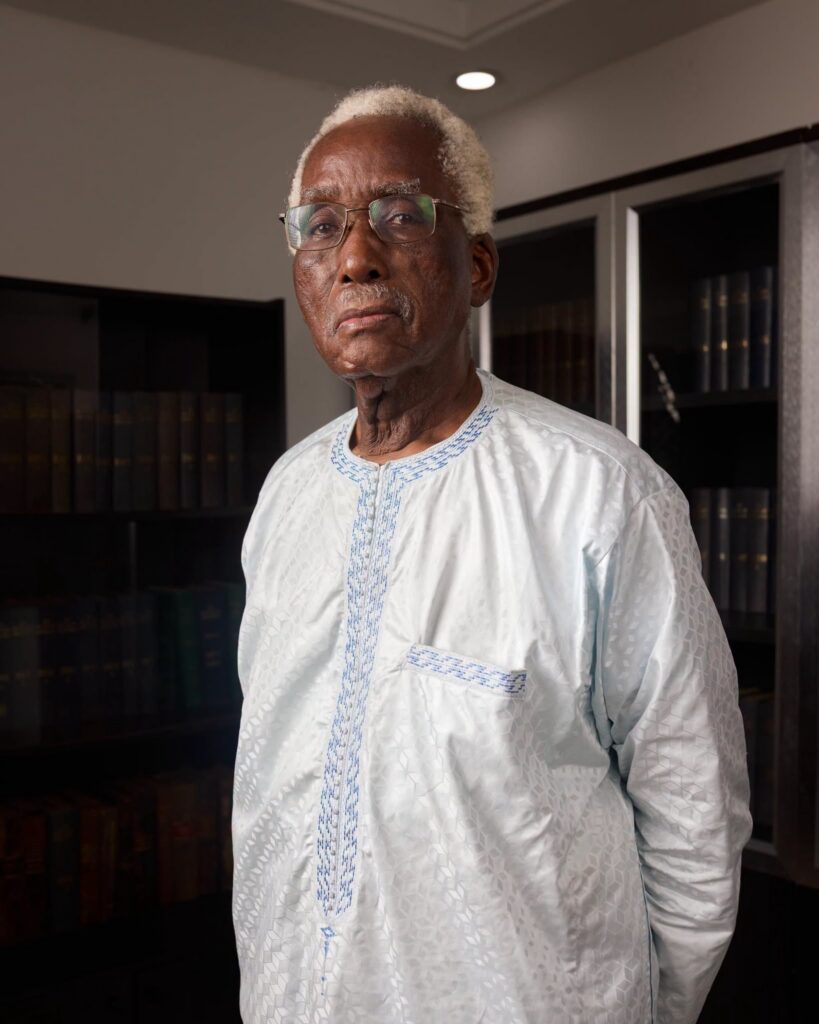
Fatoumatta: This Thursday Tribute honors Senior Counsel Antouman B. Gaye, whose quiet courage steadied a nation in its darkest years, whose humanity transcended the courtroom, and whose integrity became a moral anchor in a republic struggling to breathe. In an age of fear, he stood gently but firmly, shaping the conscience of The Gambia with a decency that endures.
Every Thursday, we pause to honor Gambians whose lives have strengthened the moral architecture of our republic. Today’s tribute celebrates Senior Counsel Antouman B. Gaye, a man whose quiet courage helped carry this nation through its most suffocating years. In every nation’s political night, some figures do not shout, do not posture, do not seek the spotlight, yet their steadfastness becomes the scaffolding upon which the republic survives.
Senior Counsel Antouman B. Gaye is undoubtedly one of The Gambia’s most brilliant legal minds, celebrated for his profound understanding of the law and his exceptional ability to anticipate legal and political developments with remarkable precision. His keen intellect, meticulous reasoning, and mastery of constitutional matters have established him as one of the most formidable lawyers in the country.
Beyond his ability to foresee legal outcomes, he is also a respected legal mind and policy thinker whose contributions continue to shape The Gambia’s legal landscape. His articulate arguments, persuasive advocacy, and deep commitment to justice make him a force to reckon with in the corridors of justice. Truly, Counsel Gaye is not just a lawyer; he is a legal oracle, a silk, and a defender of the rule of law.
In The Gambia’s long confrontation with fear, few stood more gently, more resolutely, or more honorably than Antouman B. Gaye. He is remembered not only as one of the country’s finest criminal lawyers, but as a man whose humanity illuminated the moral possibilities of public life. His story is not merely a chronicle of legal brilliance; it is a testament to the power of decency in an age of brutality.
Every republic, at its most fragile moments, relies not on the loud proclamations of politicians but on the quiet, stubborn courage of principled citizens. In The Gambia’s bruising confrontation with authoritarianism, few figures stood as steadily, as humanely, and as honorably as Antouman B. Gaye. His name occupies a special place in the moral memory of the nation — not because he sought fame, but because he carried responsibility with a grace that made him indispensable.
He is widely regarded as one of the finest criminal lawyers of his generation, a man whose advocacy shaped the contours of Gambian jurisprudence, whose courtroom mastery defended the persecuted, and whose professional integrity remained unbroken even when the state sought to crush him. Yet to understand Antouman B. Gaye fully, one must begin not with his celebrated cases, but with a moment of private humaneness that revealed the architecture of his character.
Fatoumatta: I still remember in 2003, the moment Senior Counsel Antouman B. Gaye walked into the Independent office in Kanifing South; it is impossible to forget. Standing well over six feet tall, with broad, linebacker-like shoulders and a frame built for the rigors of courtroom battle, Senior Counsel Gaye did not simply enter a room; he transformed its atmosphere. When he first stepped into The Independent newsroom, the air itself seemed to shift. He filled the doorway with a quiet authority that did not announce itself but was immediately felt.
And then there was the mustache, that impeccably groomed, distinguished sweep of silver and black that framed his upper lip like a signature. It was not flamboyant, not ostentatious, but dignified: the kind of mustache worn by men who have lived through storms and learned to walk through them with grace. It gave his face a solemn, statesmanlike bearing, softening the intensity of his height and broad shoulders with an elegance that made him instantly memorable.
Fatoumatta: It was July 2003. The Independent had published a story by reporter Sana Camara titled “Gambia: Child-Scavengers Attract Attention!” It chronicled the heartbreaking plight of children rummaging through the Bakoteh dumpsite for food, unkempt, hungry, invisible to the state. The next afternoon, a senior lawyer walked into our newsroom unannounced. In those days, lawyers often arrived with summonses, threats, or warnings. But Antouman Gaye sat down quietly, spoke softly about the suffering of those children, and handed me a brown envelope filled with money, no cameras — no press release. No performance.Just a simple, humane request: “Let us see how we can help the children.”
That moment, unpublicized, unrecorded, unperformed- revealed the moral foundation upon which his entire legal career rests. In a country where generosity is often staged for applause, Antouman Gaye’s compassion was instinctive, private, and profound. He did not represent me. He did not represent The Independent. He did not seek credit. He acted because suffering offended his conscience. This is the essence of the man: a lawyer whose humanity is not an accessory to his profession, but its animating force.
Yet his humaneness is only one chapter of a larger, more formidable story — a story written in courtrooms, detention cells, and the dangerous corridors of political trials under Yahya Jammeh’s rule.
Under the dictatorship, Antouman B. Gaye became one of the most targeted lawyers in the country. He defended political detainees when defending them was an act of rebellion. He stood beside the persecuted leadership of the United Democratic Party, represented Ousainou Darboe when the state sought to break the opposition through legal intimidation, and confronted prosecutorial machinery designed not to dispense justice but to manufacture fear. His advocacy was fearless. His cross‑examinations were surgical. His courtroom presence was a masterclass in principled defiance. He argued not as a man seeking victory, but as a citizen insisting on the rule of law in a country where law had been weaponized.
For this courage, he paid a heavy price. He was arrested, detained, and humiliated, held for four days in prison, a punishment meant to silence him. But like all true defenders of liberty, he emerged stronger. His detention became part of the documented brutality of the era, a testament to the lengths the regime went to crush dissent and the lengths he went to uphold justice.
He was appointed as lead public prosecutor in the NIA 9 case in late May 2017 to prosecute former senior officers of the National Intelligence Agency (NIA) implicated in the death of activist Solo Sandeng. His later appointment as Special Prosecutor was not merely a professional milestone; it was a moment of historical symmetry. The same man the dictatorship once tried to break was entrusted with prosecuting its most notorious instruments of repression. In that courtroom, Antouman Gaye did not seek vengeance. He sought truth. And in doing so, he helped restore the moral architecture of a nation emerging from fear.
His courage was not confined to the courtroom. When the Bar Association opposed the appointment of Chief Justice Faal, Antouman Gaye stood among the senior lawyers who supported the nomination. It was a moment that revealed his independence of mind, a refusal to be swept by factional winds, a commitment to institutional stability over personal alliances. In a legal community often fractured by politics, he chose principle.
To write about Antouman B. Gaye is to write about a man who embodies the virtues that sustain a republic: courage without theatrics, compassion without performance, integrity without compromise. He is a lawyer whose brilliance is matched only by his decency; a man who defended the oppressed at great personal risk; a citizen whose quiet acts of kindness illuminate the moral possibilities of public life.
His story invites literary parallels. He is reminiscent of the steadfast advocates in Chinua Achebe’s political novels, the moral witnesses in Camus’ chronicles of resistance, the jurists in Mandela’s memoirs who stood firm when law itself was under siege. Like Atticus Finch in To Kill a Mockingbird, he represents the lawyer as a moral compass, the advocate whose courage is not loud but steady, whose integrity is not performative but lived.
Counsel Gaye belongs to the lineage of African legal giants, men like Ghana’s J.B. Danquah, Nigeria’s Gani Fawehinmi, and Kenya’s Pheroze Nowrojee, who understood that the courtroom is not merely a site of legal contestation but a battleground for the soul of the nation.
But Antouman Gaye’s significance extends beyond the courtroom. He represents a particular tradition of Gambian lawyering, a tradition forged in the early post‑colonial years when the legal profession was still small, intimate, and anchored in a sense of public duty. In those days, lawyers were not merely advocates; they were custodians of the republic’s moral order. They defended not only clients but the very idea of justice.
Under Jammeh, that tradition came under assault. Many lawyers retreated into silence. Some collaborated with power. Others fled. But a few, a very few, stood firm. Among them, Antouman Gaye was a pillar. His defiance was not theatrical. He did not shout. He did not grandstand. He refused to surrender the dignity of his profession. And in doing so, he preserved something essential for the nation’s future: the belief that law could still be a refuge for the oppressed.
His humaneness, too, deserves deeper reflection. The brown envelope he handed me in 2003 was not charity; it was jurisprudence in its purest form. It was the instinct to defend the vulnerable even when no courtroom is present. It was the recognition that justice is not only a legal principle but a moral obligation.
In that moment, he embodied what the philosopher Emmanuel Levinas called the ethics of the face, the idea that responsibility begins when one encounters another’s suffering. Antouman B.Gaye saw the faces of those children in Sana Camara’s article, and he responded. Not with rhetoric. Not with condemnation. But with action. This is the kind of moral reflex that cannot be taught in law school. It is the kind of decency that reveals the true measure of a man.
As The Gambia continues its journey toward democratic consolidation, the legacy of men like Antouman B. Gaye becomes even more vital. In an era of political polarization, institutional fragility, and the resurgence of populist rhetoric, his example reminds us that the republic is sustained not by noise but by character.
He teaches us that courage need not be loud to be effective. That compassion need not be public to be transformative. That integrity, once lived consistently, becomes a form of quiet power. He is, in every sense, a good man. And good men are the pillars upon which republics stand.
In the end, the measure of a nation is not taken in its monuments, its slogans, or its ceremonies, but in the character of the men who defend its conscience when conscience is under siege. Antouman B. Gaye is one such man. His courage was steady, his compassion instinctive, his integrity unbroken. He walked through the darkest corridors of our history carrying a small, stubborn flame, and because he carried it, the rest of us could see.
Fatoumatta: May his example endure. May his decency inspire. May his courage remind us that even in the bleakest hours, there are Gambians who refuse to surrender the republic’s soul. And may The Gambia never forget that among its defenders, few stood taller, more gently, or more honorably than Antouman B. Gaye.